Emma Brooks
Free guide
A practical guide
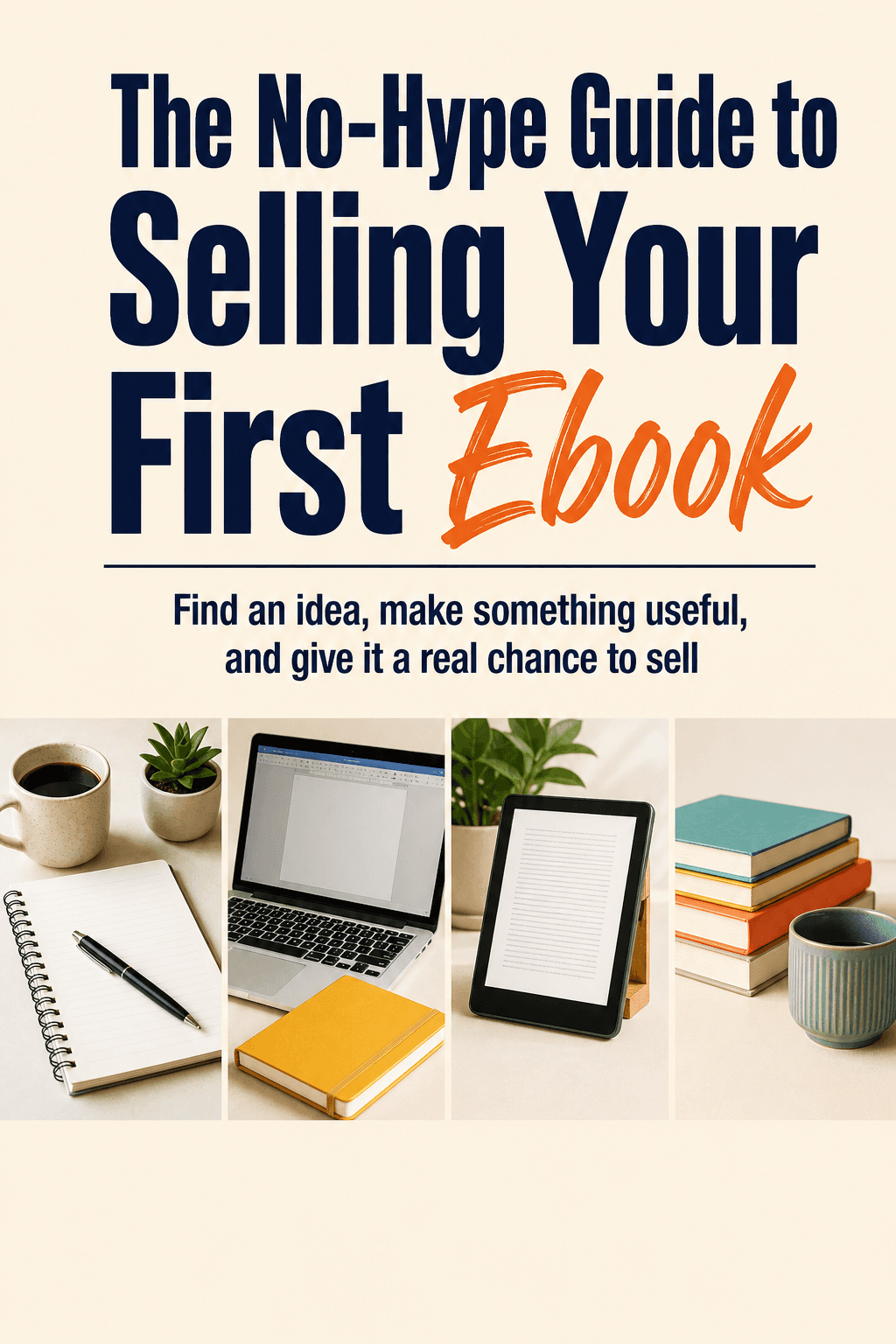
The No-Hype Guide to Selling Your First Ebook
Emma Brooks
Find an idea, make something useful, and give it a real chance to sell
99 pages · about 80 minutes to read · PDF
About this guide
Written for ordinary people who want to earn money from ebooks and have no audience, no publisher and no interest in income screenshots. It covers the whole loop in nineteen chapters: how to find topics people are already searching for, how to score ten ideas down to three, how to turn one into a focused ebook, how to price and list it on Amazon KDP, Etsy or Gumroad, and how to read the first week of numbers when nothing sells. It is honest about the odds — your first ebook may make nothing — and its argument is that one failure is one data point rather than a verdict on the business. Free, from Emma Brooks.
Inside the guide
19 chapters, and what each one leaves you able to do.
- 01
Choose Ten Problems Worth Solving
You leave with a list of ten problems you could plausibly turn into an ebook.
- 02
Score Each Idea on a Five-Point Test
You score your ten ideas and keep only the three that clearly pass.
- 03
Size Up the Demand Before You Write
You compare terms on Google Trends and search marketplaces to spot a useful gap.
- 04
Pick One Audience and One Outcome
You commit to a single reader and a single result, and you write the working title.
- 05
Build the Outline Backwards From the Result
You draft a chapter list that takes the reader from their start to your promised outcome.
- 06
Write Your First Draft Without Stalling
You finish a rough full draft, accepting imperfection to get something to improve.
- 07
Cut the Filler and Verify the Facts
You remove repetition, check your claims, and add checklists and templates where useful.
- 08
Check Your Grammar and Read It Aloud
You proofread your draft, listening for awkward wording, and fix anything you stumble on.
- 09
Make the Cover Earn Its Place
You design a thumbnail that reads clearly at small size and sells the outcome.
- 10
Write a Description That Matches the Book
You draft opening lines that state the problem and the result without overselling.
- 11
Set a Price You Can Test and Adjust
You compare similar ebooks and choose a price you can change later based on sales.
- 12
Prepare Your Listing Images and Previews
You create interior previews that show exactly what the buyer gets inside the file.
- 13
Publish on Your First Marketplace
You upload your ebook, keywords, categories and listing to one platform and go live.
- 14
Study Your First Week of Numbers
You look at views, clicks and sales, and you write down what you still do not know.
- 15
Diagnose a Failing Listing Step by Step
You identify which part of the funnel lost buyers and change one thing at a time.
- 16
Decide Whether to Fix, Park or Replace
You judge the ebook against its data and choose to improve, abandon, or start the next.
- 17
Research the Next Idea Before the Next Launch
You run the demand check once more and shortlist five follow-up topics from your winner.
- 18
Build a Small Catalogue Around One Buyer
You list three related ebooks your existing customer would want next.
- 19
Run Your Publication as a Weekly Ritual
You set a recurring hour to check numbers, update listings and plan the next test.
Look inside
Two real pages, set exactly as they print.
01
Choose Ten Problems Worth Solving
You leave with a list of ten problems you could plausibly turn into an ebook.
This kit is for anyone who has thought about selling an ebook but has not started, or who started and stalled because the idea felt too big or too vague. By the end of this chapter you will hold a list of ten problems you could plausibly turn into an ebook, written in a form you can test tomorrow. That list is the foundation for every other decision in this process, so we begin there, not with covers or pricing or platforms.
The first decision you have to make is not which topic to write about. It is which problems you already know enough about to help someone solve. You do not need to be a world expert. You need to have lived through the problem, fixed it for yourself, or watched other people struggle with it close up. That experience is what lets you write something useful rather than another summary of search results.
Take a blank sheet of paper or a fresh note file. Set a timer for twenty minutes. Write down every problem you have solved in the last two years, paid or unpaid, that you could explain to a stranger in ten minutes. Include work problems, home problems, hobby problems, and problems you have helped a friend or colleague with. Do not judge whether they are book-worthy yet. The goal is volume, so write until the timer stops.
You will probably produce between five and twenty items. If you have fewer than ten, add problems you have researched out of genuine curiosity, or problems you have seen asked repeatedly in forums, comment sections, or conversations. If you have more than ten, keep all of them for now. You will narrow them down in the next chapter, but the raw material needs to be broad.
Who wrote it
Emma Brooks helps first-time authors turn what they know into an ebook that sells.
Emma Brooks